
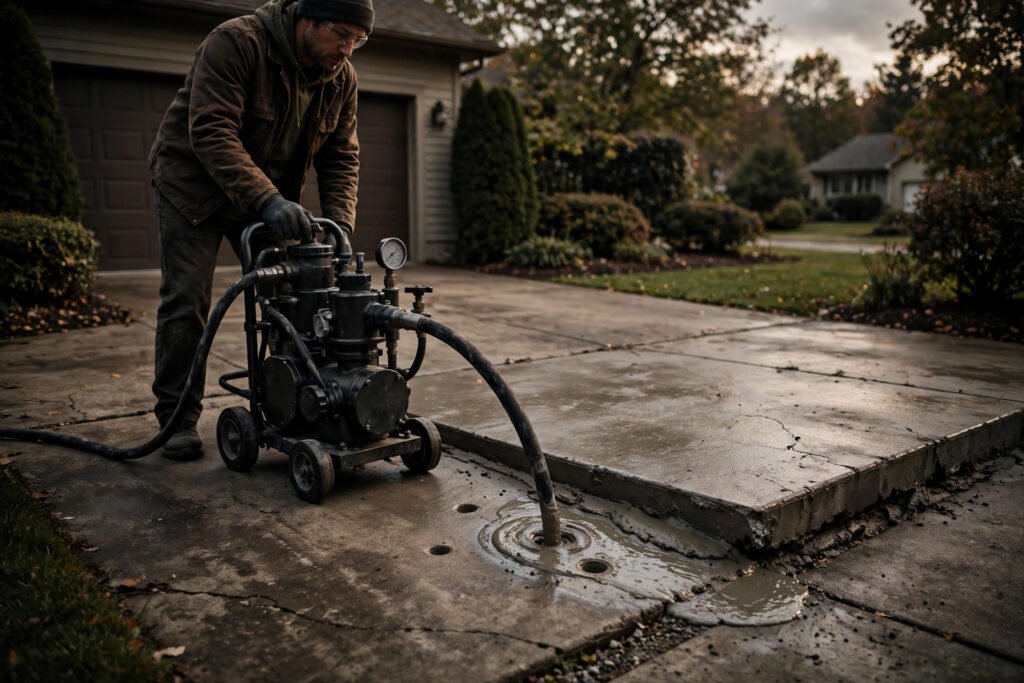
Slab Jacking in Corpus Christi
When a driveway, patio, walkway or pool deck has dropped but the concrete is still solid, we can often lift it instead of tearing it out. After years working around Corpus Christi clay, I know the first question is not “Can we pump it?” It is “Why did it sink, and will lifting it hold?”
What slab jacking actually does
Picture your concrete as a heavy lid sitting on compacted soil. Corpus Christi clay shrinks hard in dry weather, then swells when Gulf rain soaks it. That movement can leave an empty pocket under one side of the slab. With no support underneath, the concrete settles into the gap.
Slab jacking puts support back where it is missing. We drill small access holes, pump material beneath the slab, and watch the surface as it rises. A cement-based slurry is commonly called mudjacking. Lightweight expanding polyurethane is commonly called foam lifting. Both fill voids and raise concrete; the right material depends on the slab, access, weight and how precise the lift needs to be.
Signs your concrete may be ready to lift
A low spot does not automatically mean the whole slab is ruined. These are the conditions I look for before recommending concrete lifting.
Sunken driveway
One panel sits below the garage apron or curb, yet the concrete is mostly intact.
Uneven patio or pool deck
Sections have dropped at the joints, making furniture rock or leaving sharp edges near the pool.
Walking trip hazard
A sidewalk or front walk has a raised lip where one slab has settled lower than the next.
Water pooling
Rain collects in a low area or runs back toward the house because the original slope has changed.
Our slab jacking process
No mystery and no blind pumping. We check the concrete, control the lift, and stop when the slab is supported—not when somebody wants to chase a perfect number.
Assess the slab
We check cracks, thickness, joints, drainage and the direction of settlement. Badly broken concrete is not a lifting candidate.
Drill access holes
Small holes are placed where the material can reach the voids and lift the panel evenly.
Lift and watch
Slurry or polyurethane is introduced in controlled amounts while we monitor the slab and nearby joints.
Seal and clean
We stop at a safe elevation, patch the holes, clean the area and explain when the surface can go back into use.
Slab jacking vs. replacement in Corpus Christi
I would rather tell you a slab is too far gone than lift it and leave you with level concrete that is still falling apart. Here is the honest dividing line.
Jacking makes sense when…
The concrete itself is strong and the main problem is lost support or a changed elevation.
- Cracks are limited and the panel still holds together
- The slab has dropped, not crumbled or badly heaved
- The goal is to remove a trip edge or restore drainage
- We can reach and fill the void beneath the concrete
Replacement is better when…
Lifting cannot give weak, badly damaged concrete its strength back.
- The slab is shattered into several loose pieces
- Surface scaling or deep deterioration is widespread
- The layout, thickness or slope needs a full redesign
- Tree roots or another obstruction must be removed first
Corpus Christi soil is part of the decision. If drainage keeps washing out the base—or active clay keeps opening the same void—lifting without correcting that cause is only a temporary answer.
Slab jacking questions homeowners ask
Mudjacking uses a heavier cement-based mix and can be practical on larger, open areas. Polyurethane uses smaller holes, adds less weight, expands into tight voids and allows more precise control. We match the material to the slab, soil, access and amount of lift—not to a one-method-fits-all sales pitch.
No. Lifting may close some height difference across a crack, but it does not make broken concrete new again. If the driveway is badly fragmented or deteriorated, replacement is usually the sensible investment.
We patch every injection hole when the lift is complete. The patches may be noticeable at first because new repair material rarely matches weathered concrete exactly, but they are kept small and finished flush with the surface.
That depends on the lifting material and the load. Polyurethane sets quickly; cement-based slurry needs more curing time before heavy vehicles return. We give you a clear use time for your specific job before we leave.
It fills the present void and restores support. Long-term performance also depends on controlling the cause—especially drainage, leaking lines, poor runoff or repeating clay movement. We look at those conditions before recommending the lift.
Let’s find out whether your concrete should be lifted or replaced
Show us where it dropped and what happens when it rains. We will check the slab, the soil and the drainage, then explain the practical options in plain language.
Related foundation services
Concrete movement can be part of a larger soil or drainage problem. These services cover the other repairs we handle around Corpus Christi.